Blog Post #3 Navigating Identity and Resilience: Dujuan in the Documentary: “In My Blood It Runs”
- huang ziqing
- Aug 14, 2024
- 3 min read

Updated: Aug 24, 2024
Documentary film “In My Blood It Runs” presents an important vision on the Indigenous subjectivity in the contemporary Australia. This film is a powerful and emotional portrayal of the life of a young Indigenous boy named Dujuan who has to fight for his and his people’s rights in the course of his education in Australia.

In My Blood It Runs. (2024). Abc.net.au. https://cdn.iview.abc.net.au/thumbs/1200/zw/ZW2219A001S00_5ef19b17d03bf.jpg
Theme:This documentary raises a very crucial social-economic-political issue of culture identity and struggle within the framework of colonialism and current world norms. Through the film, Dujuan, a young Arrernte and Garrwa woman, navigates the educational system that erases and discredit Indigenous epistemologies and pedagogies. The film thus sends the audience an invitation to see the beauty of the Aboriginal culture and the need to keep the culture even in the face of difficulties.
(Figure1,Interview with dujian)

Theory:Michael Renov in his theory of 2021 divides documentaries into four basic tendencies namely recording, persuading, analyzing and expressing. This theory can be used to explain how ‘In My Blood It Runs’ documents the life and culture of the Dujuan people, shows the struggles of the Indigenous people and then persuades the viewer to care for these social issues. It is also possible to move to the discussion of the specifics of the film and its meaning and effect in the society and culture. The ideas of participatory culture as postulated by Jenkins et al. (2016, p28) can be easily associated with the , ‘In My Blood It Runs’. The movie depicts how Indigenous people are often excluded from the historical and societal discourse yet, through films and other social media, these marginalized voices can be heard. This is consistent with the idea put forward by Leaver and Highfield (2016) of ‘Instagrammatics’, where visual storytelling takes on significance as a way of giving voice to culture and cause. The film however, not only depicts the story of Dujuan but also raises awareness of the viewers to participate in Indigenous human rights and education.
Process:I cut this video in a montage technique (Wikipedia Contributors, 2019) way that would depict Du Juan’s life in detail and in close up by using his own footage, interviews of his family and interactions with the community. The videography depicts the beautiful Australian back drop but this is set against the Aboriginal lifestyles, and to enhance the main theme of the video, the use of shots of the landscape with no people in it. This approach does not only reveal the cultural value of this land, but also demonstrate the modern fight against racism and unequal education systems.
(Figure 2, describe Montage Transition)
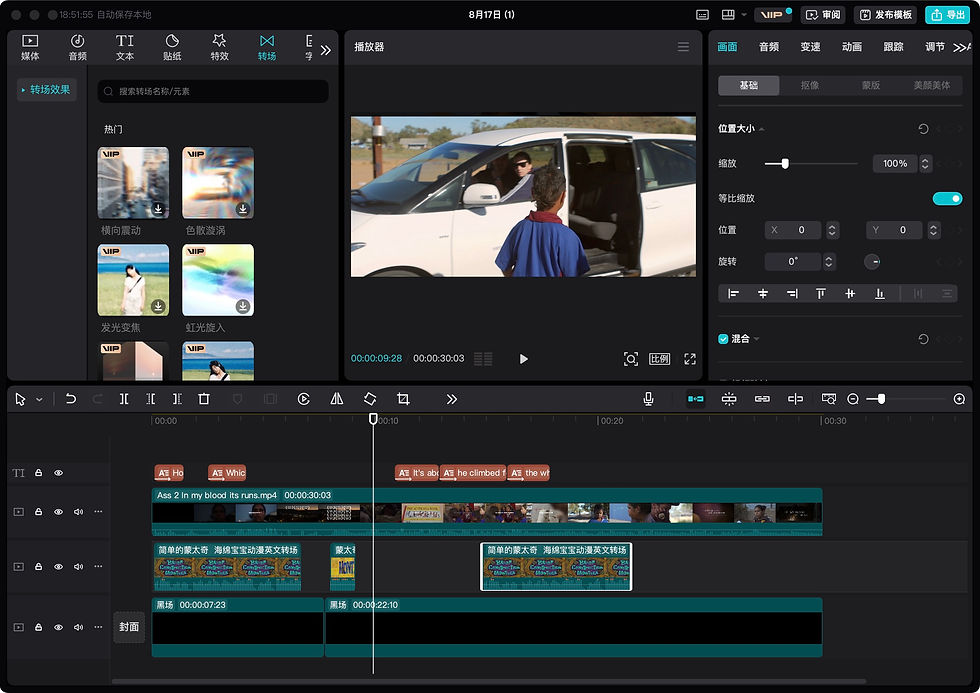
(Figure 3,Pilot film)
Conclusion:With “In My Blood It Runs”, the audience is taken through a new kind of travel experience through the Indigenous culture and the current struggles of the community. Through the documentary, the audience can also realize the significance of digital media when it comes to the telling of the Indigenous stories and how different platforms can be used in passing the stories.
The film shows how visual media can communicate with the audience and make them think about the subject of Indigenous concerns. Through the concept of culture of participation provided by Jenkins et al. , the documentary calls the audience to take action regarding the Indigenous rights and education in Australia.
Reference:
ellewilliams.com. (2023). In My Blood It Runs. In My Blood It Runs. https://inmyblooditruns.com
Media Studies. (2021, February 15). Documentaries - Codes and Conventions. Media Studies. https://media-studies.com/documentaries/
Highfield, T., & Leaver, T. (2016). Instagrammatics and digital methods: studying
visual social media, from selfies and GIFs to memes and emoji. Communication
Research and Practice, 2(1), 47–62. https://doi.org/10.1080/22041451.2016.1155332
Jenkins, H., & Shresthova, S. (2016). By any media necessary: The new youth activism. New York University Press.
Wikipedia Contributors. (2019, September 8). Soviet montage theory. Wikipedia; Wikimedia Foundation. https://en.wikipedia.org/wiki/Soviet_montage_theory


Comments